FOR TEAMS THAT SELL TO LOCAL GOVERNMENT
Win and retain more public contracts
What towns are planning and buying, inside the AI tool your team already has open.

WORKS IN CLAUDE · CHATGPT · GEMINI
START HERE · 20 MINUTES
See it work, on your territory, in the tool you already use.
The demo is the product. We open an AI chatbot, ask the municipal record about your market, and pull up a live lead. Then we follow that same lead as far as you want to take it, while you watch. Nothing to install and nothing to connect on your side.
STEP 01
Find your most relevant leads
STEP 02
Research them as deep as it deserves
STEP 03
Move what you find into your CRM
What comes back when you ask
WHAT WAS ASKED
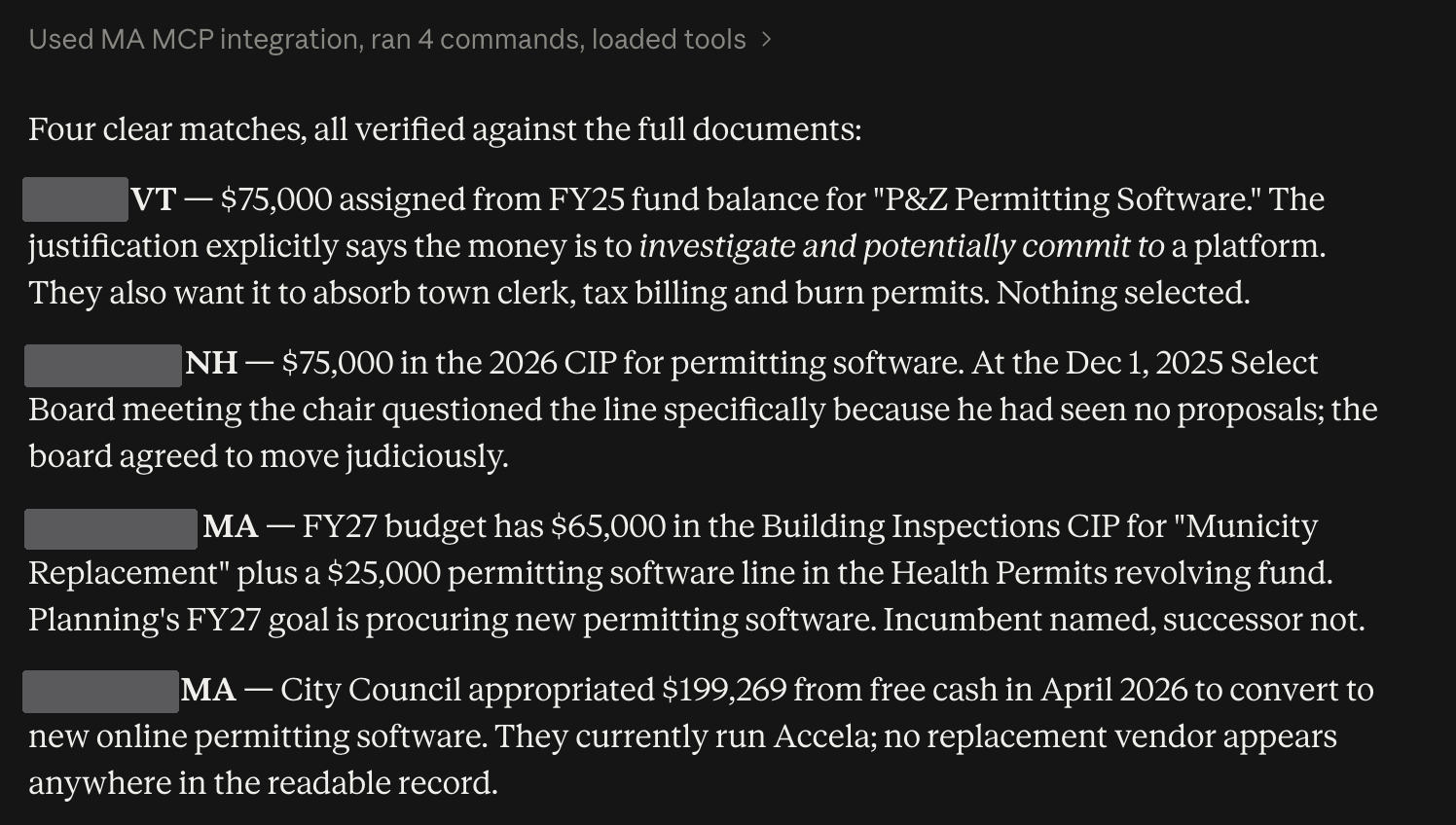
Which towns in New England have budgeted for permitting software but not picked a vendor?
Four towns across three states, each with the budget line, the dollar figure, the stage it has reached and the incumbent where the record names one.
WHAT WAS ASKED
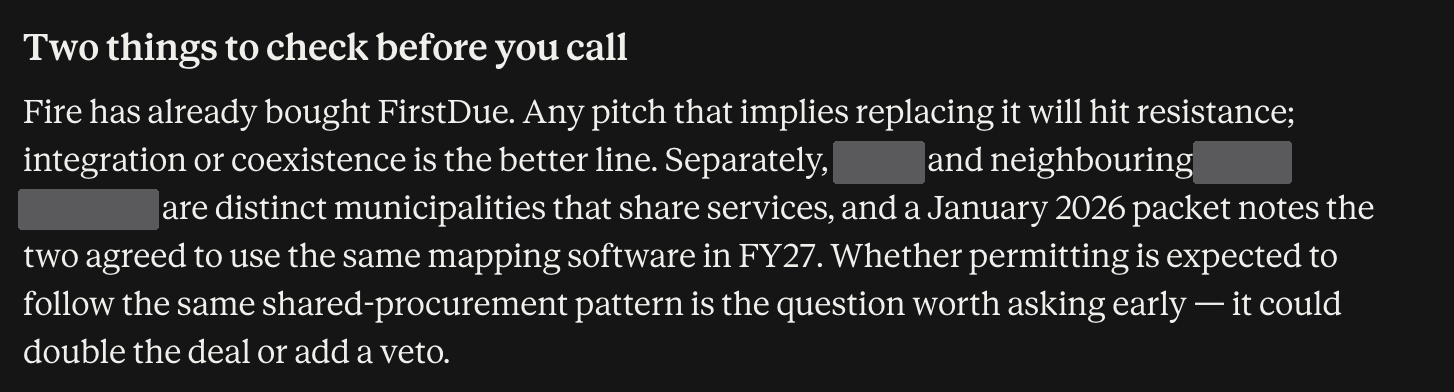
Get me more detailed information on [town] that helps me understand in more detail who to speak to and what potential pain points the town mentions
Two things that would have cost you the call. The fire department already owns a system you would be pitching against, and a neighbouring town shares services, so procurement may be shared too.
WHAT WAS ASKED
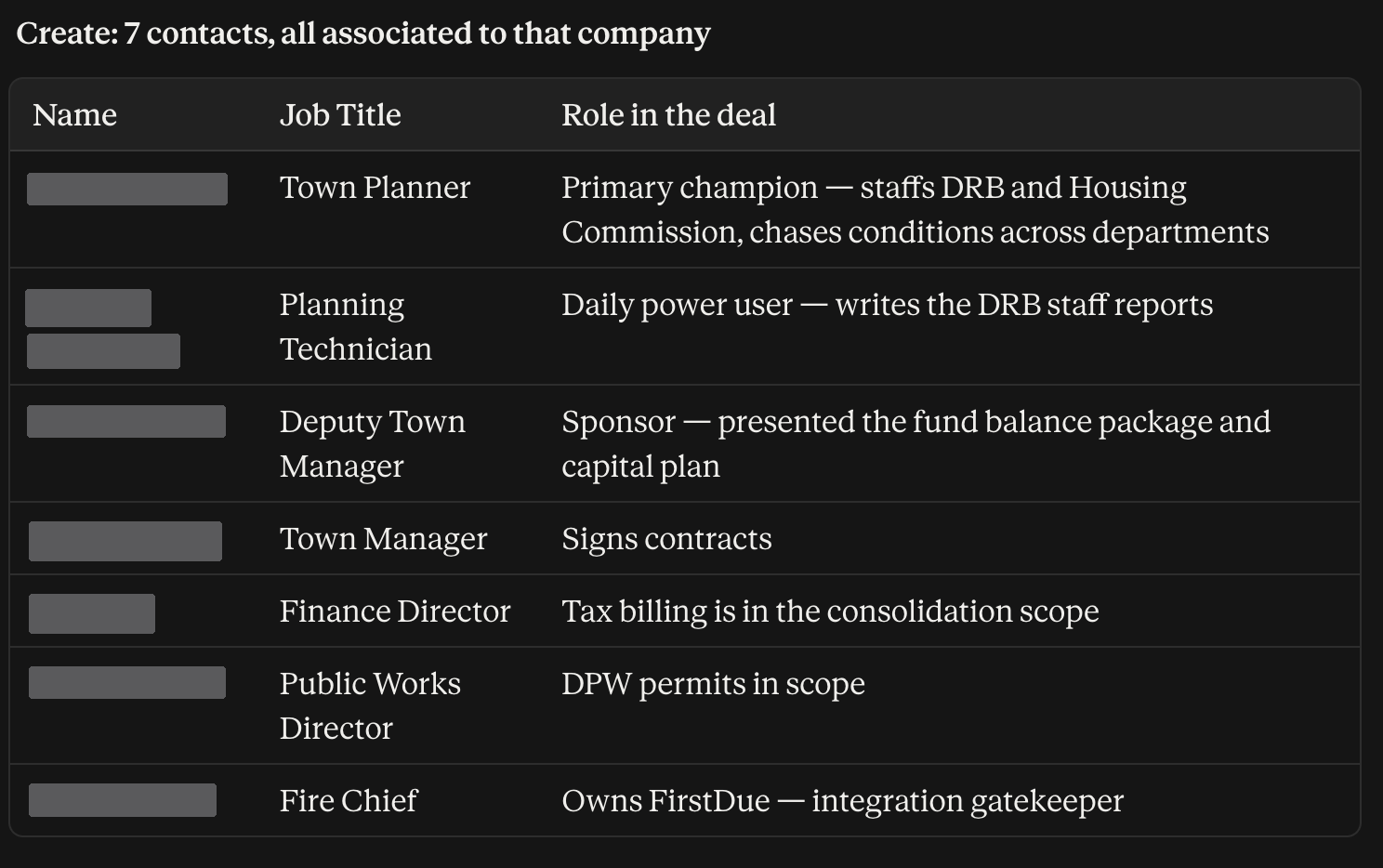
Push all the details on [town] into HubSpot
Seven contacts created against the company record, each carrying the role it plays in this deal rather than a job title alone.
Run 9 September 2026 · town and staff names redacted · everything else is the unedited session.
NOTHING TO INSTALL · NO NEW LOGIN · NO SEATS
Available where your team already works
The record answers inside the assistant they already have open.
How the connector worksOne connector serves everyone
Priced on coverage, recency and depth. The same whether two people ask or twenty.
Live the day you connect it
Nothing to install, nothing to configure, no data to load first.
Your records stay yours
They stay in your systems. We never ingest them.
Two questions your team can ask any day.
Pipeline and churn.
GROW THE BOOK
Net-new pipeline, sourced from the record instead of a list.
Budget lines that fund what you sell, before procurement opens.
Committee discussion of a capability you already ship.
Jurisdictions matching your best-fit accounts, by behavior not firmographics.
PROTECT THE BOOK
Renewal risk, flagged while there is still time to work it.
A competitor's name entering minutes in a jurisdiction you hold.
An RFP drafted for a service you're already delivering.
Your champion leaving, or the line item moving department.
In their words, not ours.
"The overall contract price isn't super super helpful. The dates of the contract, competitor who's in there, sentiment around it, when there's upcoming meetings talking about it, all that stuff is gold for our selling team."
Go-to-market VP, SLED software vendor
"A utility-scale solar moratorium tells me someone applied at the planning board and they already don't like it."
Platform lead, renewable-energy investment firm
"You'll find out about them, it closed two months ago, and we didn't know about it. It's really about getting in early."
Competitive intelligence lead, national tower REIT
Bring one market. We pull a live lead
out of it while you watch.
Twenty minutes, in an AI assistant you already have open.