Monthly update, May 2026
This is the public mirror of an email sent to a private list on 2026-05-26. The body below is the email with minor edits to remove internal pipeline jargon. Numbers are point-in-time as of the send date; the corpus is live and these figures will have moved.
Quick May update. Cleanest data point this month is the Neudata Scout listing producing two cold-inbound alt-data evaluators in the same morning, 50 minutes apart, both at champion-profile match. That moves the buyer-side wedge thesis from internal argument to first external cluster.
What I saw this month
The buyer-side wedge thesis got its first external proof points. Two of them, same day, same channel.
On 2026-05-08, the Neudata Scout listing (live since April 8) generated two cold inbounds 50 minutes apart. Both at funds where the inbound contact has a champion-profile role for alt-data acquisition.
The first was the data sourcing lead at Balyasny Asset Management. Discovery call held the same week. The contact is evaluating Municipal Alpha in the same cohort as NationGraph and FiscalNote, and that cohort framing is the interesting part. Both of those are sold to government-vendor sales teams. Municipal Alpha is the only one in the cohort selling to investors. The conversation confirmed a hypothesis I have been operating on without external evidence: alt-data buyers at multi-strat funds get routed to government-affairs vendors today because investor-targeted government-data products are rare. That is the gap MA fills, and a credible buyer has now named it.
The second was BlackRock's Data Strategy and Solutions group, routing MA to the Systematic Active Equity team. The intro thread carried the SAE researcher (public equities, branching into real estate) from the start. Live call held May 18; the routing contact opened and dropped to another meeting after the first third, and the SAE researcher drove the substantive remainder solo. Unprompted, the researcher articulated the differentiation: the lead-to-lag relationship between municipal documents and tower-REIT or data-center-REIT activity is "very differentiated and not really available in the marketplace." The call closed with the category-level affirmation that this is "a differentiated area of alpha." The researcher took the conversation back to internalize before specifying use cases, which is the right behavior on a first call and what I want to see from a serious buyer. Next move on their side. SAE's methodology is breadth-over-depth with a 7-year history floor, which lines up with MA's actual corpus shape on the document classes that have the breadth (parcels, building permits, FAA tower filings).
Two things to read out of that pair of conversations. The first is that Neudata is showing a first cluster, not a one-off listing, with two champion-profile inbounds the same morning, both still warm. The second is that BlackRock SAE arriving at MA via a "real estate research" use case and updating mid-call to the lead-to-lag layer is the model-update behavior that turns a discovery call into a real evaluation. Whether this repeats is the open question for June; the next-month focus is converting either one to a paid evaluation.
There is a third read worth naming. Municipal Alpha's coverage is broad, three thousand-plus municipalities across a dozen-plus signal verticals, but any given buyer only cares about one slice. The corpus is doing double duty: signal source for the buyer, prospecting engine for the seller. Neudata is the most legible example, a categorized listing that surfaces alt-data buyers actively scouting for new sources, but it generalizes. Indexing tower-aggregator-shaped FAA filings surfaces which carriers and aggregators have portfolio exposure. Indexing PFAS pre-treatment signals surfaces which environmental consultants are in the market. Coverage is the lead-gen mechanism, and broad expansion into new verticals is not speculative because the corpus itself qualifies who in the market should care.
The same week, three other things happened that sharpen the picture:
The SLED-vendor cohort raised. Pursuit closed $22M Series A on 2026-05-01 (Builders VC), and a competitor I had not been tracking, Starbridge, surfaced with a $42M Craft Ventures Series A from October 2025 plus a $10M earlier seed. Combined with NationGraph's $18M Series A from February, that is roughly $80M of fresh capital deployed against the same raw substrate Municipal Alpha collects, all on the vendor-selling-to-government side of the buyer line. Two reads on that: one, the category is fundable at meaningful scale, which is validation; two, the investor-side wedge I am holding is the segment the venture money is not chasing, which is the asymmetry the business runs on.
Pursuit also shipped an MCP server. That is the most copyable product-packaging move in the cohort this period. Their data is now callable natively inside Claude and Cursor, which is where the AI-stack analyst workflow already lives. If MA ships an investor-side read-only MCP server in the next two quarters, it is a wrapper on what already exists, not a new product. Worth a session of founder time on the question.
FiscalNote got delisted from the NYSE on 2026-04-13 after failing the $1 minimum bid test, ran a 25% workforce reduction, and is under a forbearance agreement that just expired May 21. Their Curate product (the municipal-meeting platform the BAM contact was also evaluating) is now an in-play asset. In any future buyer-eval where Curate shows up alongside MA, parent-stability is now in MA's favor.
Pipeline
Eight conversations in motion this month worth naming.
Kite Realty Group is the freshest data point on the corpus-as-leadgen pattern named earlier. Cold outreach to Tom McGowan, president and COO, at 9:30 AM this morning, surfacing the jurisdictional shift pattern across retail corridors (rezoning to residential and mixed-use, parking minimums dropping, drive-through and big-box ordinances tightening) months before it shows up in tax bills. McGowan replied within an hour asking what the service costs. Quote went back same session: $300K annual flat-rate national subscription, $30K 90-day pilot that credits to the annual if it converts. Same-day price-discovery on a public REIT vertical the morning the cold batch launched.
BlackRock SAE (the substantive contact is the SAE researcher; Data Strategy and Solutions handles the routing) is the largest by buyer scale and currently the most articulated on differentiation. The researcher took the May 18 call back to internalize. Awaiting the next move; followup artifact (a 7-year backtest cut on whichever subset of US coverage matches the use case they pick) is ready to send when they name the use case.
BAM Funds is the warmest by tempo. The data sourcing lead has the v4 overview deck and the cohort framing. Next move on their side; they said they would follow up with specific use cases.
Maine Venture Fund call held May 7. Posture shift from discovery to active connector plus post-bootstrap follow-on investor. The partner I spoke with validated the bootstrap-first stance, endorsed the channel-partner-first GTM, and asked to be on this update list. Maine ecosystem activation continues compounding.
Companyon Ventures, call held May 7 alongside Maine Venture Fund. Sent the v4 overview deck. The partner framed the bootstrap path as "legacy vs retirement" optionality, which is a useful internal framing.
New North Ventures, a new VC conversation opening this month. Warm intro through a Maine ecosystem connector, v4 overview deck delivered.
GroundVue (the public-meeting AI play out of the federal civic-tech world), call held May 7. Adjacent-not-competitive read: they sell to policymakers, we sell to investors, same raw material, different buyer. June 10 follow-up on file. Lateral-distribution thesis (license MA's corpus into their state-by-state rollout, NLC and NACo as channels rather than city-by-city sales) captured for the followup.
Christian Milz (former Acast colleague, now Aceve Product Director) submitted MA's first external contributor pull request on April 24, code that fixed a Brookline MA coverage gap. Clean diagnosis, sharp execution, set the bar for what an external contribution looks like in this codebase. Not a buyer signal, a team-and-network signal.
From April's update, four conversations are still warm with no May movement: AMT (verbal pilot from the 4/10 call, not yet papered), MTLN (grant decision still pending June 12), PFAS Laboratories, and SW Cole Engineering.
Below that line, sixty active touchpoints across twelve segments in the prospect DB. Two hundred eleven prospect events in the last thirty days (eighty cold-email sends, forty-six replies, nine meetings booked, three pilots in early discussion). The funnel exists; the next-month focus is converting BlackRock, BAM, or KRG to a paid evaluation or pilot.
Pricing and ACV shape by vertical
The shape of what is in play, not a forecast. Verticals with explicit pricing signal or analog comps:
REIT operators: $300K annual flat-rate national subscription is the live quote (KRG above), with a $30K 90-day pilot that credits to the annual if it converts. First explicit price-discovery in this vertical, first quote sent.
Tower aggregators: $12K annual floor (AMT's $1K per month verbal, not yet papered), $60K-150K ceiling on multi-state rollout or the referral-and-exclusivity premiums the AMT call floated. April's envelope still holds.
Institutional alt-data buyers (multi-strat, quant, SAE): $50-200K annualized typical for a Neudata-listed product. BlackRock SAE and BAM conversations are the active discovery surface, both still pre-pricing.
Environmental consultants and NE geotech: $5-15K annualized for the PFAS Labs and SW Cole segment shape.
Local news and civic-tech: grant-funded scoping ($5-10K via the MTLN model) or low-monthly subscription ($500-750 per month if a post-grant subscription converts).
Envelope today: the same $20-25K of explicit deals on the table from April, no May movement on those. What changes the picture is the KRG quote in flight at $300K annual plus the BlackRock SAE and BAM threads opening price-discovery. One conversion at REIT or institutional pricing lands what was the entire April ceiling on its own.
Speaking and ecosystem
Municipal Alpha is part of NSIH, the Roux Institute's startup hub at Northeastern's Portland campus. That association compounded materially this month.
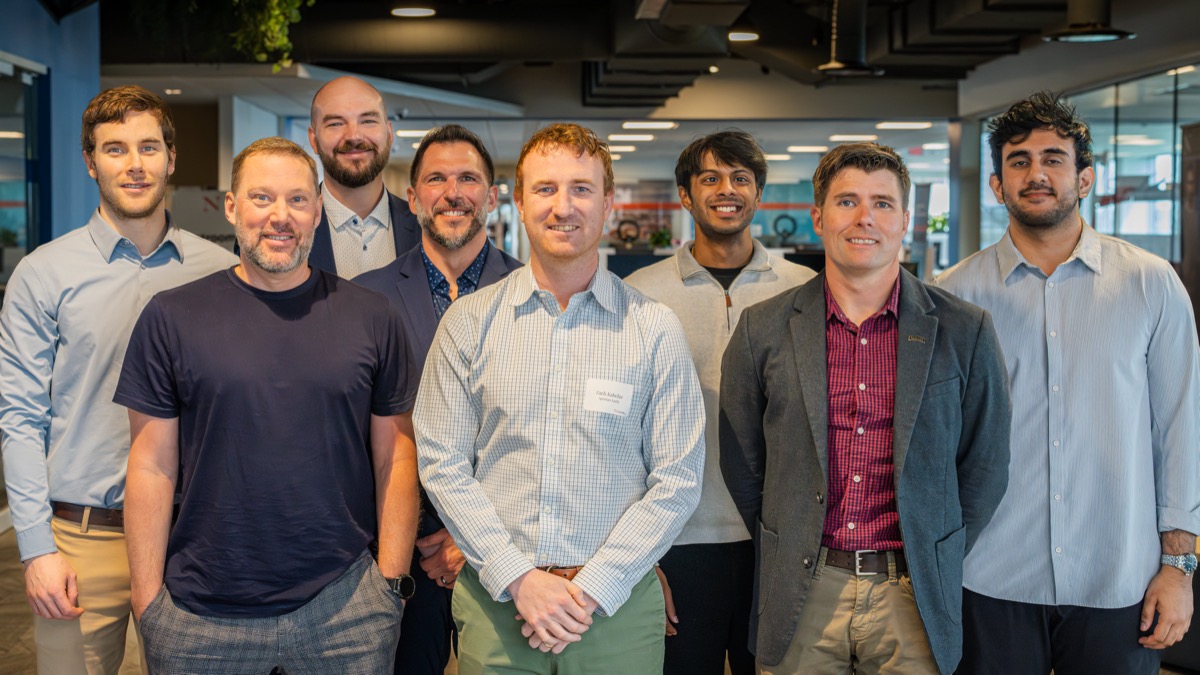
Spoke on a panel at Startup Maine Week on May 18 about how a one-person company runs on AI at roughly $391 a month. The format was useful because the audience was founder-to-founder and the question that came out of it was "is this just AI productivity, or is the corpus the actual asset?" The right framing for ecosystem audiences (corpus plus cost as proof of the AI-productivity-thesis-applied-to-itself) versus buyer audiences (corpus first, cost surfaces later as sustainability proof) became a captured rule that future audience-mapping inherits.
Two more speaking slots are confirmed in the next two weeks, both downstream of the Roux relationship.
NENS Conference (Northeast National Security Conference, NH Tech Alliance) on June 3 in Portsmouth NH is a 7-minute Tech Showcase slot. The audience is defense and national-security tech with federal procurement exposure, which lines up with the foreign-aligned-vendor watch-list demo I have been building against the corpus. Slides due May 29. nhtechalliance.org/nens-conference-2026-agenda
AI in Action 2026 Business Summit on June 5 at the Roux Institute in Portland ME is a speaking slot on the Municipal Innovation track. Offer came through a Roux contact I met at Startup Maine Week, routed via NSIH's director, confirmed this week. Format and length still being pinned down. events.humanitix.com/ai-in-action-2026-business-summit
The pattern worth naming: NSIH membership plus the NSIH director acting as a connector is the throughline. NENS came through a Roux-adjacent founder forward; AI in Action came directly through NSIH; the Startup Maine Week panel was where the in-person meeting that produced AI in Action happened. Same root, three branches. The "Roux Institute is reaping benefits" call is the right read of the month.
Numbers (point-in-time 2026-05-25)
- 3,171 municipalities indexed across 72 states and jurisdictions. 1,025 produced new documents in the last 30 days. The denominator is broader than April's 2,600+ figure; the active-in-30-days number is the honest "live" count.
- 584,566 source documents in the corpus, up from 472,000 in April.
- 433,743 classified signals (excluding noise-filtered and unclassified), up from 84,000 in April.
- 104,323 new documents in the last 30 days; 44,747 in the last 7 days. The recent surge is partly dark-matter recovery (re-downloading 5,000+ aged-out documents on the buyer-bundle patterns) and partly a data-processing fix from May 23 draining a backlog.
- 169,149 parcel records across 26 Maine municipalities (the parcel layer that feeds the tower, redev, and credit verticals).
- Monthly infrastructure cost: roughly $391 (DigitalOcean, Anthropic, ScraperAPI, Google Cloud, Google Workspace). No revenue yet, but BlackRock SAE and BAM are the first conversations that have the shape of paid relationships from the alt-data side.
The meta layer
This is the part where capex compounds into opex reduction on every future customer, which is as much the business model as the product is.
Three things shipped this month that I notice future sessions inheriting:
Data integrity gates at ingest time. Two parcel validators, one at the per-batch level and one at the post-commit audit level, promoted to load-bearing. Four real ingest failures in May where a value column landed 100% NULL because the format detector pointed at the wrong source column would now block at the upsert. The 2026-05-15 audit that surfaced these was itself a Gemini-reviewed plan, so the gates and their accepted residuals are both auditable.
Bootloader trim plus memory audit v2. Today's session pulled roughly 17 kilobytes out of the always-loaded context surface (about 10 percent), which lowers the per-session token spend and the reading load on every future session. The memory-audit tool was rebuilt around explicit "reviewed-on" frontmatter on every memory file, which encodes the judgment of "is this file still load-bearing" rather than inferring it from edit dates. Same shape as the validators: encode the judgment, do not re-derive it every session.
Ephemeral crawl pipeline. The expensive piece. The whole infrastructure to spin up ephemeral DigitalOcean droplets, shard the crawl across N of them, collect quarantined manifests, and run a parity calibration against the in-process baseline before flipping a feature flag. Built and shadow-running but still calibrating; the last five nights of cron failed for three distinct reasons that all got fixed in today's session. First clean test fires on the 2026-05-26 04:00 UTC cron. If the calibration passes, the daily crawl scales from ~34 munis a night to 819. The capex here is large; the opex payoff is structural.
One thing I am wrestling with
The W21 weekly review came back with three top recommendations, and the most adversarial one is to "shift focus to OPEX and signal generation next week." Translation: the system is hardened, now run it. Specifically, more buyer conversations, more outreach in fresh verticals, more signal delivery to existing prospects. The wrestling-with is that the meta layer keeps surfacing real compound deposits (today's bootloader trim is the clearest example), and turning that engine off to do more outreach is a real cost. The honest read is that both are true and the budget question is the wrong frame; the right frame is which loop is currently the rate-limiter on revenue, and I think it is the buyer conversations, not the system. Acting on that this week.
Non-dilutive funding paths I am exploring
The bootstrap-first stance has a natural complement worth naming: non-dilutive funding that covers engineering capex without trading ownership. Two paths look most fit.
Maine Technology Institute (MTI), the state's grant arm for tech companies, runs three program shapes that map cleanly: the TechStart Grant for early-stage R&D, the Cluster Initiative for ecosystem-aligned work, and the Development Loan for commercialization. Municipal Alpha's Maine ecosystem footprint (NSIH, MVF, Roux Institute, the Maine corpus depth) makes the alignment legible.
Federal SBIR is the other path, with two relevant solicitors. DoD SBIR aligns directly with the NENS Conference June 3 slot, the foreign-aligned-vendor watch-list demo, and the federal procurement audience that produces tech-transition contracts after Phase I. NSF SBIR is the natural home for the corpus-as-substrate angle, with research-grade signal extraction as the R&D thesis.
The honest read is that I have not yet run an SBIR or MTI submission, and the process complexity is real (proposal-writing, federal compliance, timing). If you have run one, or have views on which path fits a one-person data product best, that input would be useful.
One ask
Two if I can stretch it.
More intros to alt-data evaluators at multi-strat, quant, or systematic-equity funds. The BlackRock and BAM conversations confirmed the segment is reachable through the right channel; the next move is widening it past the two warm threads to a steady inbound or outbound rhythm. Specifically: data sourcing leads, alt-data evaluators, systematic-equity researchers, anyone in a "what new vendors should we look at" role at a multi-strat, quant, or SAE-style fund. One more quant-fund intro is already in motion through a warm connector.
If you have read the v4 overview deck and have a one-line reaction, even a negative one, send it. The stable link is municipalalpha.com/decks/municipal-alpha-overview-deck-v4.pdf (unlinked from the public site, sharable forward). Reaction is the input I need to know what to sharpen.
If neither lands, no ask is fine. See you next month.
More soon.
Matt municipalalpha.com