PFAS Is Spreading Through Municipal Agendas Faster Than Groundwater
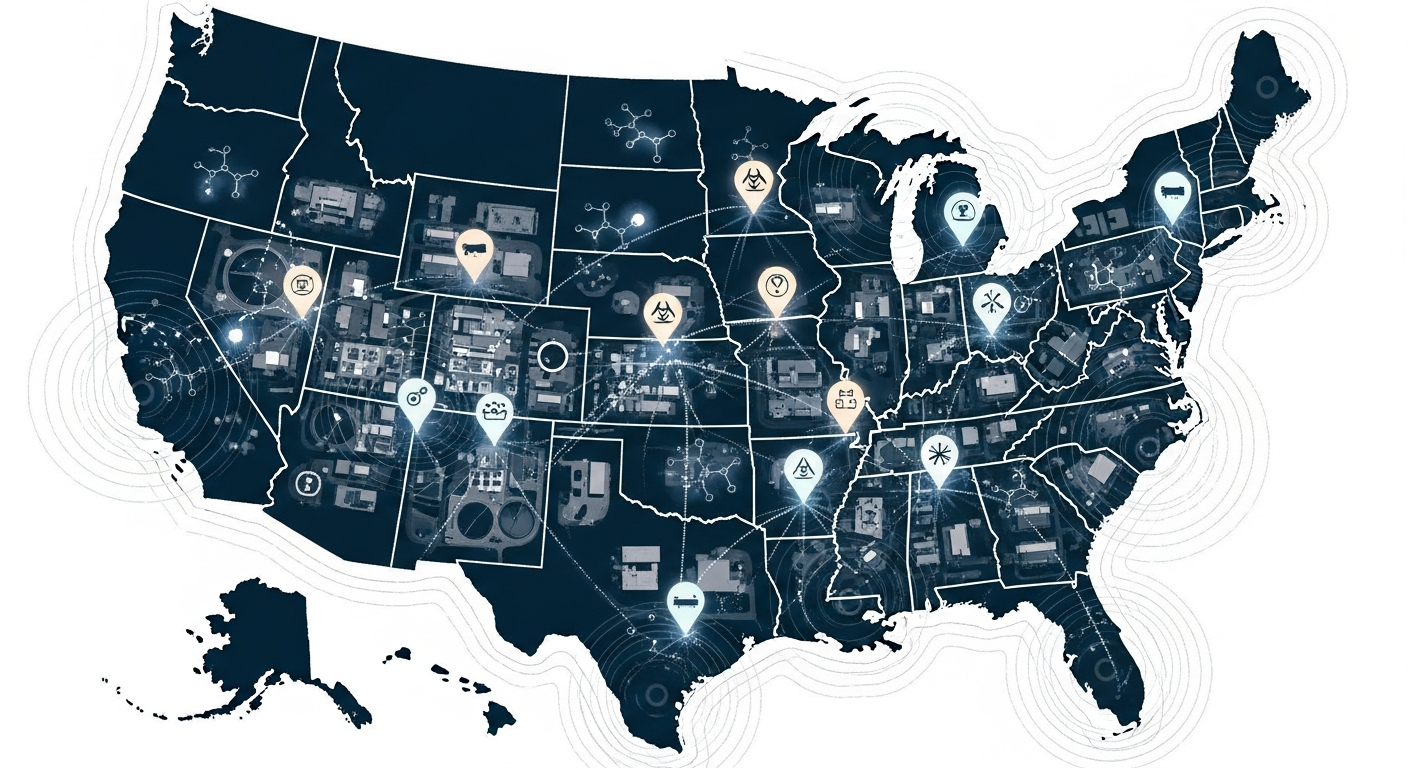
Analysis based on 120+ PFAS-related events detected across 70+ municipalities in 23 states.
The Pattern
PFAS contamination is a public health story. But before it becomes a public health story, it's a municipal agenda story. Somewhere between the first water test and the EPA press release, a planning board discusses it, a town council votes on a study, and an ordinance committee drafts new language. All of that activity is in public documents. We read them.
Our pipeline has detected 120+ PFAS-related events across 70+ municipalities in 23 states. The events range from initial studies and water testing to ordinances, moratoriums, compliance actions, and remediation contracts. The pattern is consistent: once one town in a region starts testing, neighboring towns follow within months.
The Acceleration
The trend line tells the story. PFAS was a slow trickle of events for years, then it went vertical.
| Period | Events | Towns | States |
|---|---|---|---|
| 8-10 quarters ago | 2-3/quarter | 2-3 | 1-3 |
| 4-6 quarters ago | 2-3/quarter | 2-3 | 2-3 |
| 2-3 quarters ago | 4-14/quarter | 4-8 | 4-7 |
| Current quarter | 119 | 80 | 22 |
In a single quarter, PFAS events exploded from single digits to 119, across 80 towns in 22 states. This isn't gradual adoption. It's a regulatory compliance wave hitting simultaneously, driven by federal and state deadlines converging.
Where It's Showing Up
| State | Towns | Events | Earliest Activity |
|---|---|---|---|
| Maine | 49 | 69 | October 2023 |
| Illinois | 7 | 15 | September 2019 |
| Vermont | 5 | 12 | August 2023 |
| New Hampshire | 5 | 9 | February 2026 |
| Massachusetts | 5 | 10 | October 2024 |
| Connecticut | 4 | 4 | February 2025 |
| Rhode Island | 3 | 6 | November 2024 |
| Wisconsin | 2 | 6 | February 2025 |
| + 15 more states | 18+ | 25+ | Various |
Maine leads with 49 towns, which isn't surprising -- Maine passed some of the strictest PFAS legislation in the country, and local governments are now implementing it. But the geographic spread tells a more interesting story. PFAS activity is showing up in Idaho, Hawaii, Montana, Kansas, and Arizona. This isn't a New England problem. It's a national remediation wave that's still in its early stages.
How It Moves Through a Region
The contagion pattern is predictable:
- One town tests. A water utility runs PFAS sampling, usually prompted by state-level requirements or federal guidance. This shows up as a "study" or "testing" event in our pipeline.
- Results get discussed. If levels are elevated, it hits the town council agenda. If they're not elevated, it hits the agenda anyway because residents read about the neighboring town and start asking questions.
- Neighboring towns react. Adjacent municipalities begin their own testing, often within the same quarter. Our pipeline detects the same topic appearing in nearby jurisdictions.
- Ordinances follow. The discussion phase produces new regulations -- setback requirements from contamination sources, discharge limits, monitoring requirements. We've detected 49 PFAS-related ordinance events.
- Money moves. Studies become contracts. Monitoring becomes remediation. Remediation becomes infrastructure. Every stage has a supply chain.
What It Means for the Supply Chain
PFAS remediation creates procurement demand across a specific set of public companies:
| Category | Companies | Why |
|---|---|---|
| Water treatment equipment | Xylem (XYL), Veolia (VEOEY), Badger Meter (BMI) | Filtration, monitoring, treatment systems |
| Environmental testing | Clean Harbors (CLH), Tetra Tech (TTEK) | Sampling, lab analysis, site assessment |
| Pipe and infrastructure | Mueller Water (MWA), Core & Main (CNM) | Replacement infrastructure for contaminated systems |
| Engineering and consulting | Stantec (STN), AECOM (ACM), Jacobs (J) | Design, permitting, project management |
These companies already appear in our entity sightings across dozens of municipalities. Xylem shows up in 57 towns. Core & Main in 66. Mueller Water in 56. As PFAS remediation accelerates, these sighting counts will increase -- and the spending will be visible in municipal check registers before it shows up in quarterly earnings.
The Leading Indicator
The 49 PFAS ordinances we've detected are the leading indicator. An ordinance creates a legal obligation to spend. The spending follows on a 6-18 month lag -- procurement, contracting, construction. By the time the remediation contract shows up in a check register, the ordinance that mandated it has been in our database for a year.
A municipal bond analyst looking at PFAS exposure is reading EPA enforcement actions -- lagging indicators. We're reading the ordinances that create the spending obligation. The signal is the same. The timing is different.
70+ Towns and Counting
New PFAS events enter our pipeline every week. The federal regulatory framework is still tightening (the EPA's PFAS National Primary Drinking Water Regulation took effect in 2024), and state-level implementation is driving local action. Every town that starts testing has a non-zero probability of finding something, and every finding triggers a cascade of municipal activity that our pipeline captures automatically.
The question isn't whether PFAS remediation will be a significant infrastructure spending category. It's which municipalities are already committed, and which are next.
We know. It's in their agendas.
Want this data?
We track PFAS contagion events daily across 1,800+ municipalities. The dataset includes event type, municipality, date, related entities, and supply chain tickers.
- Download a sample of our signal data (CSV) -- 50 entity-resolved signals showing the data structure
- See our full methodology -- coverage, freshness, known gaps
- Get PFAS data for your coverage area -- tell us which states or municipalities you're watching