CASE STUDY
While New York Needs More Housing, Maine Towns Adopt Housing Caps
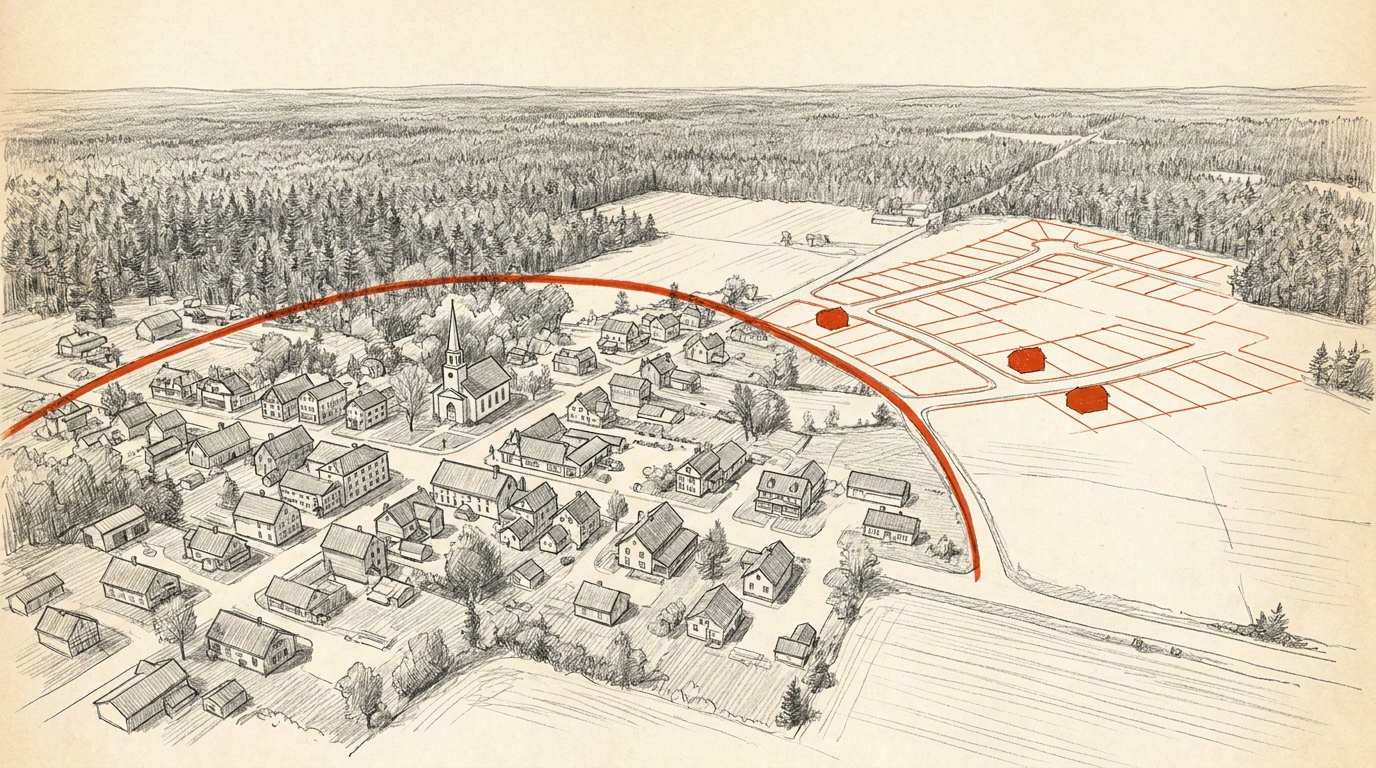
New York ties state money to towns that commit to more housing. In Maine, towns are writing yearly caps on new homes into law, and keeping them when their own planners argue against them. Both directions are written down in the towns’ own minutes.
Two states, opposite directions
New York ties state money to building. Maine towns cap how many homes get built.
New York’s Governor set a goal of “800,000 new homes over the next decade to meet the historic shortage.” The state now makes Pro-Housing Community certification “a requirement for municipalities” applying to key discretionary funding programs. Maine has a housing push of its own, and its law now bars growth caps in a town’s designated growth areas. Outside them, Maine towns are capping.
New York
Jan 10, 2023
2023 on
Feb 2, 2026
Jun 4, 2026
Brunswick, Maine
Nov 2025
May 4, 2026
Jun 5, 2026
Aug 3, 2026
Jan 1, 2027
The cap that stayed
Gray’s planners said the reason for its cap was gone. The council kept it, twice.
Gray, Maine
Apr 2026
Aug 4, 2026
Aug 13, 2026
Aug 18, 2026
What Maine’s law leaves open
Maine’s 2026 housing law, LD 2173, says a town “may not enact or enforce rate of growth ordinances that limit residential development in designated growth areas” except under strict conditions. For every other part of town: “A municipality may adopt a rate of growth ordinance applicable to all other areas without limitation by this section.” LD 2173 as filed in South Berwick’s June 16, 2026 hearing record
Towns noticed. In January, Cumberland’s Town Council voted 7-0 for a resolution that says “Maine faces a significant housing shortage” and, in the same text, that “the prohibition on growth caps in designated growth areas eliminates a critical tool.” It asks the Legislature to “repeal LD 1829 or delay its implementation.” Town Council minutes, January 28, 2026
Where it is on record now
Scarborough, Maine
On August 19, 2026 the Town Council voted 7-0 on the second reading of its 2027 home-permit allocation under its Rate of Growth Ordinance, after moving five permits to the rural area for an approved subdivision. A resident spoke about “the reduction in permits” and questioned the fairness of the process.
Source: Town Council minutes, August 19, 2026, in the September 2 packet
Falmouth, Maine
Town staff told a council committee on October 6, 2025 that one of the biggest proposed changes is “to reduce the town-wide cap for development outside of the Town’s growth districts,” and that the town “will eventually be having additional discussions in future years about further reducing growth allowances outside of the growth areas.”
Source: Community Development Committee minutes, October 6, 2025
Limerick, Maine
In July 2025 the town’s code officer, reporting on the year’s building permits, said “He would like to see the Moratorium that has been discussed come into place”; the draft covered subdivisions of 7 or more. The moratorium “was approved at the Special Town Meeting on 9/2/25.”
Source: Select Board minutes, July 21, 2025 · Select Board minutes, September 8, 2025
Why it matters
Where new homes may be built, and how many each year, is decided town by town, often by one or two votes. New York is paying towns to say yes. Maine’s towns are writing caps into law in the places the state still allows them. If you build, finance or buy land for housing, the cap that shapes your next year is already in a town’s minutes. Tell us the towns you work in, in the box below, and we will find the caps on their record.
If you sell software to towns
Every permit runs through somebody’s software, and usually through somebody’s payment screen. A town that commits to more homes is about to get busier at the permit desk: that is a reason to get its attention. A town that caps or pauses building gets quieter, and its rules get harder to run: that is the moment to look after the customer you already have. The signal only means something once you know who already serves the town. We read that from the same records: which vendors a town pays, and which way its housing rules are moving. Tell us your product and your towns in the box below.
METHODOLOGY: Every example above comes from the town’s own record, linked beside it. Agendas, packets and workshop papers show what was proposed; we say adopted or voted only where minutes or the adopted ordinance show it. Where minutes are drafts, or were filed inside a later meeting’s packet, the source says so.
GET IN TOUCH
What would this look like for you?
We'll show you what the record says about it, as a one-time deep dive or an ongoing service. Your first consultation is free.