Lead Pipes Are a $50B Problem Hiding in Municipal Agendas
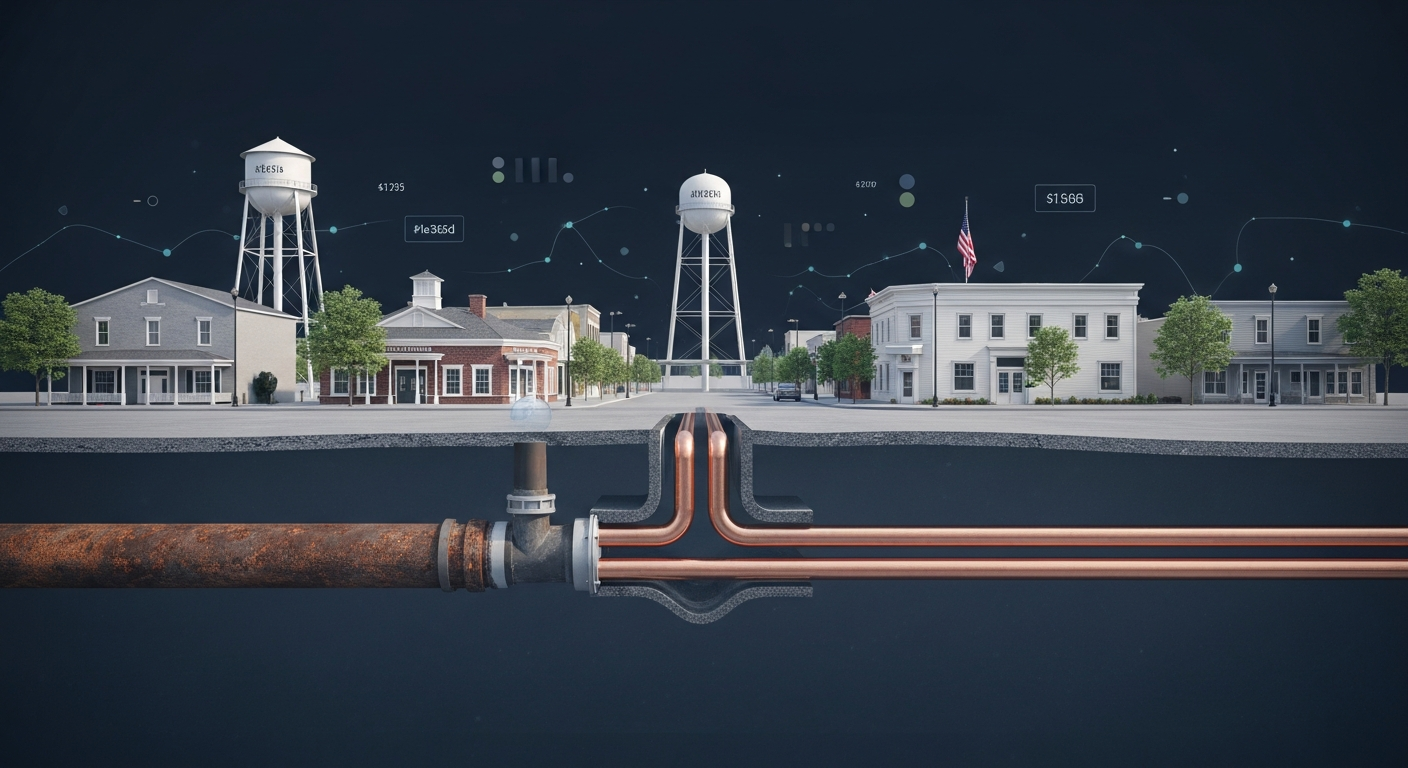
Analysis based on 75+ lead service line events detected across 39 municipalities in 13 states.
The Federal Mandate Nobody's Tracking Locally
In 2024, the EPA finalized the Lead and Copper Rule Improvements (LCRI), requiring all water systems to identify and replace lead service lines within 10 years. The estimated national cost: $20-50 billion, depending on who's counting. The money will flow through municipalities -- and the spending decisions are already showing up in their public documents.
Our pipeline has detected 75+ lead service line events across 39 municipalities in 13 states. The events include studies, inventory surveys, compliance plans, construction contracts, and funding allocations. This is the leading edge of a national infrastructure mandate, visible in municipal agendas before it shows up in any federal spending report.
The Ramp
The quarterly trend shows a mandate moving from study phase to action phase.
| Period | Events | Towns | Primary Activity |
|---|---|---|---|
| 8-12 quarters ago | 1-3/quarter | 1-2 | Studies, inventory |
| 4-7 quarters ago | 4-6/quarter | 2-3 | Ordinances, construction begins |
| 2-3 quarters ago | 3-5/quarter | 2-3 | Contract awards, compliance |
| Current quarter | 43 | 33 | Votes, compliance surge |
The pattern: studies first, ordinances next, contract awards following, and then 43 events across 33 towns in the current quarter as the compliance wave hits. The October 2027 inventory deadline is approaching, and municipalities are moving from planning to action. The spending ramp hasn't started yet -- this is the pre-spending signal.
Where It's Happening
| State | Towns | Events | Stage |
|---|---|---|---|
| Maine | 23 | 33 | Inventory and early replacement |
| Vermont | 1 | 20 | Hartford alone -- deep into implementation |
| Illinois | 2 | 6 | Compliance planning (Clarendon Hills, Skokie) |
| Idaho | 2 | 4 | Inventory phase (Pocatello, Kootenai County) |
| Wisconsin | 1 | 5 | Wisconsin Rapids -- active replacement |
| Massachusetts | 3 | 3 | Early study phase |
| + 7 more states | 7 | 6 | Various early stages |
Hartford, Vermont stands out with 20 events from a single municipality -- the deepest lead pipe data trail in our pipeline. This is what full implementation looks like: inventory surveys, engineering studies, construction contracts, compliance reports, public hearings, and funding applications, all flowing through town council and water department agendas over months.
Maine leads in town count (23), consistent with the state's older housing stock and proactive water infrastructure approach. But the spread across 13 states shows this isn't regional -- it's the first wave of a national mandate.
The Implementation Cascade
The LCRI creates a predictable sequence of municipal activity:
| Phase | Action Type | What We See | Timeline |
|---|---|---|---|
| 1. Inventory | Study, survey | Towns cataloguing their pipe materials | Now - 2027 |
| 2. Planning | Compliance, regulation | Engineering plans, cost estimates, funding applications | 2025 - 2028 |
| 3. Procurement | Contract, award | RFPs for replacement work, vendor selection | 2026 - 2030 |
| 4. Construction | Construction, permit | Active replacement, check register payments | 2027 - 2034 |
We're mostly seeing phases 1 and 2 right now -- 21 study events, 7 ordinances, 6 compliance actions, 6 construction events. The procurement and construction phases are where the real spending hits, and they're just starting.
The Supply Chain
Lead service line replacement creates concentrated demand for a specific set of companies:
| Category | Companies | Municipal Presence |
|---|---|---|
| Pipe and fittings | Core & Main (CNM) | 66 towns, 935 sightings |
| Water meters and infrastructure | Mueller Water (MWA) | 56 towns, 181 sightings |
| Water treatment and monitoring | Xylem (XYL) | 57 towns, 341 sightings |
| Meter technology | Badger Meter (BMI) | 63 towns, 282 sightings |
| Water utility operations | American Water Works (AWK) | 61 towns, 683 sightings |
| Treatment systems | Veolia (VEOEY) | 40 towns, 207 sightings |
These companies already have deep municipal footprints -- they're the existing vendors for water infrastructure. Lead service line replacement doesn't require new vendor relationships; it scales existing ones. Core & Main is already in 66 of our municipalities. When those towns start replacing lead pipes, Core & Main supplies the fittings. The spending increase will be visible in check registers.
The Funding Trail
Municipalities don't pay for lead pipe replacement alone. Federal and state funding flows through multiple channels:
- EPA Water Infrastructure Finance and Innovation Act (WIFIA) loans
- State Revolving Fund (SRF) grants and low-interest loans
- Bipartisan Infrastructure Law allocations ($15B for lead service line replacement)
Each funding source creates its own paper trail in municipal documents -- grant applications, acceptance votes, budget amendments, matching fund allocations. We detect these as separate events. A "grant_acceptance" event in one town tells us that town just secured funding and construction follows. A "capital_funding" event tells us the town is committing its own resources.
The funding events are the earliest signal that spending is imminent. By the time a contractor starts digging, the grant was accepted months ago. We saw the grant acceptance in the town council minutes.
39 Towns and Counting
The LCRI requires all water systems to complete initial inventories by October 2027. That's 50,000+ water systems nationally. We're watching 39 municipalities that are already in motion. As more systems begin their inventories and compliance plans, the event count in our pipeline will accelerate.
The $50 billion question isn't whether the money will be spent. It's which municipalities are committed, what phase they're in, and which vendors are winning the work. The answer is in the agendas.
Want this data?
Lead service line events tracked daily -- inventory progress, funding approvals, contractor awards -- with municipality, phase, and supply chain tickers.
- Download a sample of our signal data (CSV) -- 50 entity-resolved signals showing the data structure
- See our full methodology -- coverage, freshness, known gaps
- Get lead pipe data for specific regions -- tell us which states or water systems you're watching