Business Retention Runs on the Worst Information. The Public Record Already Has Better.
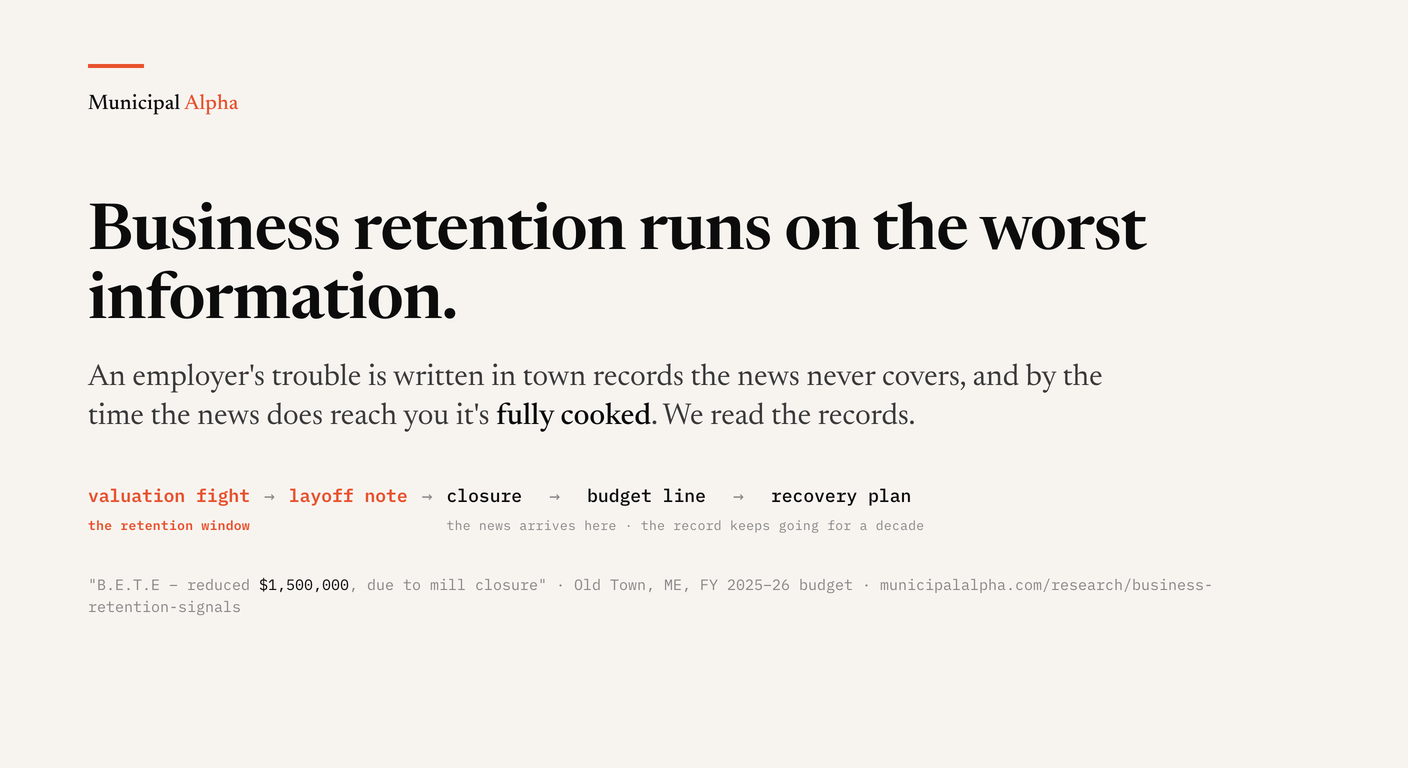
Old Town, Maine's current city budget contains a line that explains the whole problem in four words. A revenue line for BETE, the state program that reimburses towns for tax-exempt business equipment, drops by $1,500,000, and the published budget notes give the reason: "reduced $1,500,000, due to mill closure." The same document trims another $91,204 from a tax-increment district "due to mill closure," and adjusts revenue sharing by $259,828 under a state provision whose formal name says everything about how often this happens to Maine towns: the adjustment for sudden and severe disruption of valuation. Maine property-tax law has a standing form for losing your biggest taxpayer.
The mill in question stopped operating in 2023. Two budget cycles later, the city is still writing it down, line by line.
Every economic developer we talk to says some version of the same thing: keeping an employer you already have is far easier than winning a new one across the country. Retention is the cheapest win in economic development. And then they describe how they actually find out a local employer is in trouble, which is the news, arriving fully cooked, after the window to do anything useful has closed. The cheapest win in the profession runs on the worst information channel available.
The frustrating part is that the story is written down the whole time, before, during, and long after, in the public records of the towns themselves.
Where do business-retention and employer-distress signals actually show up?
In the municipal record, a major employer's trouble is not one event. It is a long paper trail with a beginning, a middle, and a very long end, and different pieces of it land in different towns' files. Here is what that trail looks like in records we monitor today.
The aftermath is a budget line, for years
Old Town is not an outlier, it is the pattern. Down the Penobscot in Bucksport, Verso closed the paper mill in December 2014, displacing more than 500 workers. Ten years later, in December 2024, the town's finance committee was still framing its budget practice around the event, in language no consultant would dare write. The committee described its long habit of conservative budgeting as "a huge protection against the 'what if' of a potential mill closure and loss of a major portion of municipal valuation," and noted that the town "no longer has the 900 lb elephant at the end of Main Street."
Out in Wisconsin, Verso idled the Wisconsin Rapids mill in 2020, laying off more than 900 workers at a mill that had run since 1904. The city commissioned a Recovery and Redevelopment Plan, completed in 2023, with an Economic Opportunities Analysis and a site-by-site reuse plan, and in May 2025 the common council was still working through it. Five years on, the closure is a standing agenda item.
That is what missing the window costs, written in the towns' own words, on a decade-long clock.
The live pulse, kept by hand, one town at a time
Now look at what the same record looks like while the story is still moving. Cheshire, Connecticut's Economic Development Commission keeps the kind of running watch every region wishes it had. A single April 2026 packet tracks a national retailer's layoff plans ("Macy's is planning layoffs at the end of March 2026"), which storefront just became available for lease, and which school opens in September. That is a town's economic pulse, taken by hand, by a volunteer commission, for one town.
The tax-base version of the same pulse shows up in assessment and litigation files. Greenwich, Connecticut's Board of Estimate and Taxation tracked, in a February 2026 packet, five pending Superior Court tax appeals with a combined fair market value of $41,301,400, alongside the note that 319 appeals have been resolved since the 2015 revaluation. A major taxpayer contesting its valuation is one of the oldest distress fingerprints there is, and it is filed in public, with dollar figures, in records the news does not cover.
The problem is that the story is scattered
A regional employer's story is rarely written in just one town's file. The abatement request lands in one town's assessor file, the budget what-if in another's finance workshop, the layoff note in a third's commission packet, and the eventual recovery plan in a fourth's council agenda. A well-run local commission like Cheshire's can keep the watch for its own town. Nobody can keep it by hand for a region of fifty towns, and the regional organizations whose mandate is retention, the development councils, growth alliances, and state agencies, are exactly the ones who need the assembled picture rather than one town's slice of it.
What this is, and what it is not
This is not a prediction engine. We are not claiming to forecast which employer closes next, and most of what a town writes down resolves into nothing in particular, which is exactly why the value is in being early to the evidence rather than in calling the outcome. What we claim is narrower and more useful: the lifecycle of employer distress, the valuation fight, the layoff note, the budget what-if, the closure line, the recovery plan, is written into public municipal records as it happens, and almost nobody reads those records across town lines. We do. A reading practice, not a crystal ball.
Two boundaries worth stating plainly. Formal layoff notices under the WARN Act are state filings, not municipal minutes, so they travel on a separate trail from the town records shown here; we treat them as a distinct source. And our municipal coverage is deepest in the Northeast and lighter as you move out from there, so read the geographic spread as a floor that is still filling in.
Methodology and sources
Municipal records come from agendas, minutes, packets, and budgets we monitor across 4,100+ US municipalities in all 50 states. Every dated example is taken from the document's own date, not from when we discovered it. The records:
- Old Town, ME · FY 2025–2026 General Budget · budget document
- Bucksport, ME · Finance Committee, December 2024 · agenda packet
- Wisconsin Rapids, WI · Common Council, 2025-05-20 · council packet
- Cheshire, CT · Economic Development Commission, 2026-04-21 · commission packet
- Greenwich, CT · Board of Estimate & Taxation, 2026-02-24 · meeting packet
Closure dates and employment figures for the Bucksport, Wisconsin Rapids, and Old Town mills are from contemporaneous public reporting, linked inline above. The Maine sudden-and-severe-disruption adjustment is 36 M.R.S. §208-A.
Back in Old Town, the budget lines will keep carrying the mill for years, the way Bucksport's records still carry theirs a decade later. The retention conversation, the one where the story could still have changed, happens much earlier than that, and it happens in the same records. The story is being written in public, town by town, while it can still change. We read it there.
Get the weekly retention read for your region
If business retention is part of your mandate, at a regional development organization, a growth council, or a state agency, tell me your region and I'll walk through what the record shows there, live.
Book a 15-minute walkthrough or matt@municipalalpha.com