The Saturation Lag: How National Controversies Start in Town Council Meetings Nobody Watches
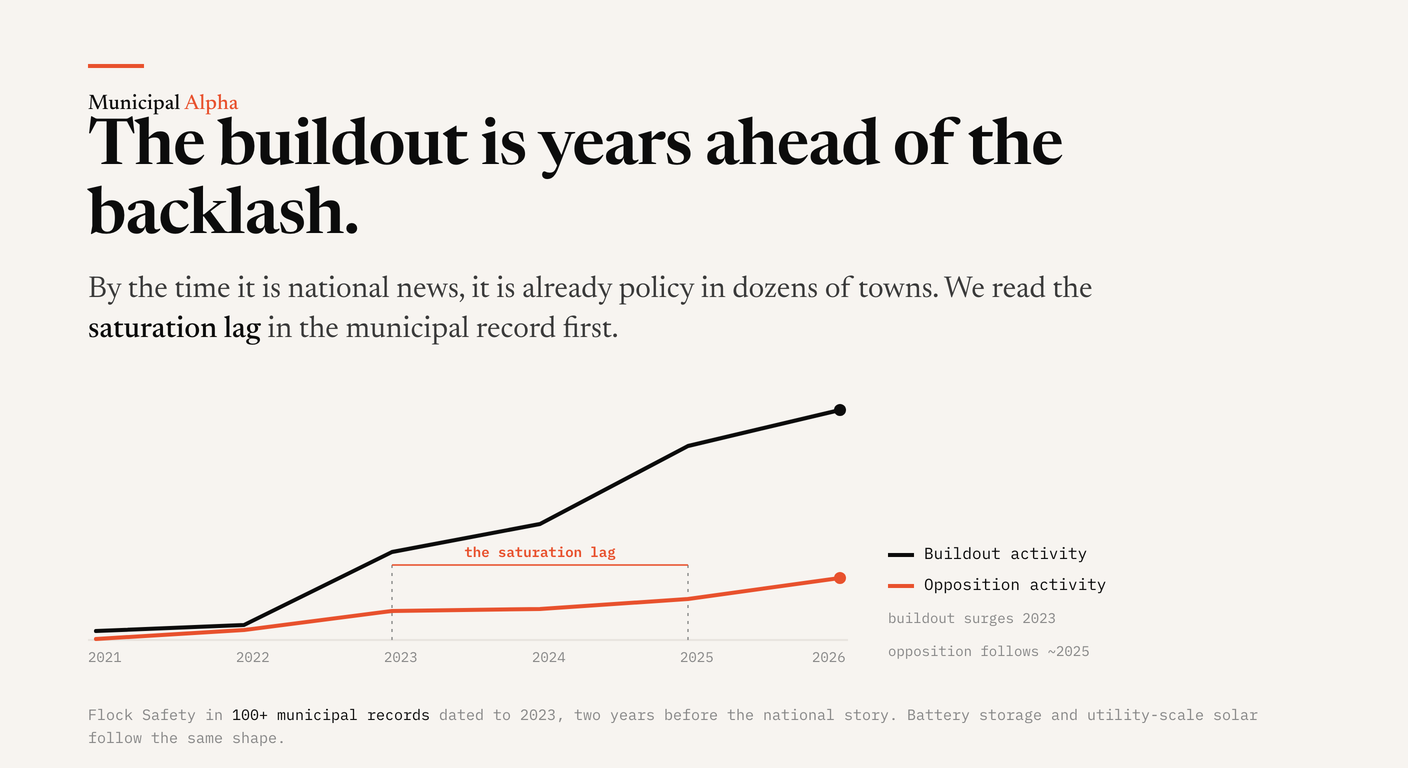
Flock Safety became a national surveillance controversy in 2025. The town council votes that quietly built its license plate camera network, and the first residents who stood up to object, are dated 2023, and they sat in public meeting minutes the entire time.
By the time a technology becomes a national controversy, it has usually already been approved one town council vote at a time, in places nobody was watching. The fight that breaks into the news is a late signal, the early signal sat in municipal agendas, minutes, and budgets for years. We call the gap between those two moments the saturation lag: the stretch of time between when a buildout starts spreading locally and when opposition reaches the threshold that makes it a national story. Across surveillance technology, battery storage, and utility-scale solar, that lag runs roughly one to two years, and it is dated in the municipal record before it surfaces anywhere else.
This is not a theory the people exposed to it need explained:
"A solar moratorium tells me someone applied at the planning board, and they already don't even like it." a solar developer we spoke with
A moratorium is the visible end of something that started months earlier, an application meeting a town that was not ready for it. That is the saturation lag from the field.
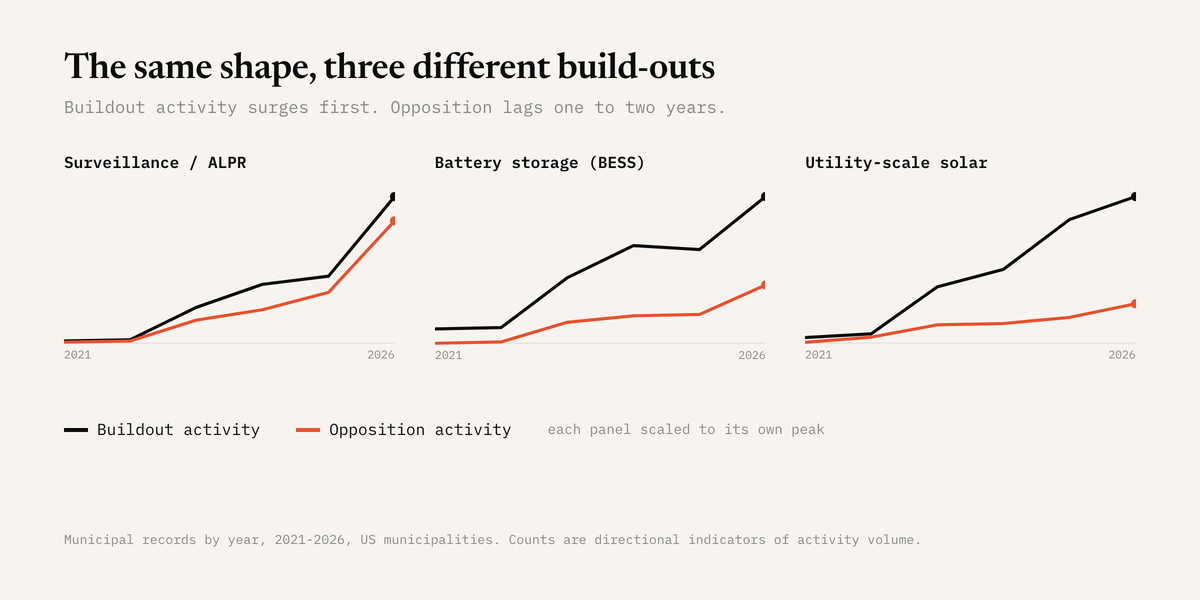
Three sectors, three different build-outs, one shape: buildout surges first, opposition lags one to two years. Municipal records by year, each panel scaled to its own peak.
How does a national controversy start in a town council meeting?
Automated license plate readers are the clearest current example. Flock Safety appears in more than 100 dated municipal records in our corpus, and the story those records tell is not the story the headlines tell.
On February 21, 2023, the Richmond, California city council approved a three-year agreement with Flock Group, Inc. for a fixed automated license plate reader system, "in an amount not to exceed $249,600." On December 31, 2023, Hanover Park, Illinois recorded in its annual financial report that "several neighboring agencies utilize Flock Safety, which will further expand the network of searchable ALPR cameras throughout Chicagoland." That one village board line item plugged the town into a regional surveillance mesh.
And on September 12, 2023, a resident named in the Lake Stevens, Washington council minutes "strongly opposed Flock Safety that was presented tonight." Adoption and the first local objection, recorded in the same public minutes, in 2023.
The national controversy over Flock did not break until mid-2025, when investigations into license plate data shared with federal immigration agencies reached the news, followed by a state attorney general lawsuit that October and a wave of more than thirty localities canceling their contracts into early 2026. The municipal record, including the first residents standing up at the podium to object, ran roughly two years ahead of the headline. That gap is the saturation lag, and the signal was public and dated the entire time.
Why don't these issues surface until it is too late to weigh in?
Because the buildout happens in the dark phase. Each individual decision is small, local, and procedural, a budget line, a grant award, a three-year service agreement. None of it is newsworthy on its own. There is no national dataset of town council votes, so there is no national picture until the local decisions saturate a region and opposition begins to spread from one council to the next.
That spread is the contagion. One town's moratorium becomes the template for the next town's moratorium. By the time it is a headline, it is already policy in dozens of places, and the businesses affected are reacting instead of anticipating.
The lag is not a promise that the backlash arrives on a schedule. Often a national trigger, an investigation, a lawsuit, a single viral incident, is what finally ignites it. What the municipal record gives you is the other half of that equation: which ground is already saturated and primed, so when a trigger lands you know where it catches first. The buildout and the earliest local friction are in the record years before the trigger shows up, even when the trigger is what makes the news.
Is this only about surveillance, or is it a repeating pattern?
It repeats. The same buildout-then-backlash shape shows up wherever a technology rolls out through municipal approvals, and the data shows opposition lagging adoption by a predictable margin.
Battery energy storage (BESS), municipal records by year:
| 2020 | 2021 | 2022 | 2023 | 2024 | 2025 | 2026 | |
|---|---|---|---|---|---|---|---|
| Buildout activity | 16 | 22 | 24 | 100 | 149 | 143 | 224 |
| Opposition activity | 1 | 0 | 2 | 32 | 42 | 44 | 89 |
Utility-scale solar, municipal records by year:
| 2021 | 2022 | 2023 | 2024 | 2025 | 2026 | |
|---|---|---|---|---|---|---|
| Buildout activity | 12 | 20 | 120 | 157 | 263 | 312 |
| Opposition activity | 2 | 13 | 39 | 42 | 55 | 84 |
The drivers differ, privacy for surveillance, fire safety for battery storage, land use and property values for solar, but the shape is the same. In each case the buildout curve jumps first, then the opposition curve follows a year or more later and compounds. That is the saturation lag, quantified. Battery storage opposition was nearly nonexistent in 2022, then multiplied through 2026 as projects saturated more counties. Solar shows the same shape, its buildout surging in 2023 and opposition compounding behind it.
What does this mean for a national business?
It means the decisions that determine whether a national business keeps operating are made in rooms that business is not in. A surveillance vendor, a battery developer, a solar operator, all of them depend on thousands of local approvals, and all of them are exposed to a wave of local opposition that is invisible until it is everywhere.
The same dynamic hits businesses built on top of municipal process, not just those seeking approvals. The shift away from newspaper public notice toward direct digital posting is moving the same way, town by town, with the legal-notice industry exposed to a saturation point it cannot see from the national level. The pattern does not care which side of the local decision a business sits on. These are local decisions, made in the dark, with outsized national impact.
How early is the pattern actually visible?
As early as the first agenda item. The records that announce a national controversy exist, dated and public, long before the controversy. The problem has never been that the signal is hidden. It is that no one reads thousands of towns at once.
That is the layer Municipal Alpha reads. We track these buildouts and the opposition that follows across the full municipal record, so the saturation lag becomes a window to act inside, instead of a headline to react to.
How do I get ahead of it for my own business?
If your business runs on local approvals, the early signal for your sector is already in the municipal record, in the same town meetings that go unwatched. We can point it at the ground you actually care about. Tell us the states and the kind of activity you track, and we will show you where it is building, which of your markets are already moving, and which are heading into procurement, the last of which tells your team who to call next.
Start with the states and the assets that matter most to you, and we will have the saturation map pointed at your footprint before we talk. Book a short call.
FAQ
What is the saturation lag? The measurable gap between when a technology starts being approved town by town and when local opposition reaches the threshold that makes it a national controversy. It is visible in municipal agendas, minutes, and budgets before it is visible in the news.
Which technologies show this pattern? Automated license plate readers and surveillance cameras (Flock Safety), battery energy storage systems (BESS), and utility-scale solar all show buildout activity surging first and municipal opposition lagging by roughly one to two years. The same dynamic affects the shift in public-notice requirements.
Where does the data come from? A corpus of municipal documents (agendas, minutes, ordinances, budgets, financial reports) across thousands of US municipalities, dated by meeting date and full-text searchable.
Methodology note: counts are drawn from a full-text index of municipal records, filtered to policy-bearing document types and dated by meeting date. Figures are directional indicators of activity volume, not a census of every jurisdiction, and named examples are quoted from the primary source document.